Sizing Guide · 23 November 2026
Most sizing mistakes happen before anyone opens a catalogue: people measure the case they already own, or they guess. Measure the kit instead, and the case almost picks itself.
Put the equipment on a table and measure its three sides — length, width, height — including anything that sticks out: connectors, a lens hood, a handle, a cable that has to stay attached. A case that fits the body but not the protruding plug is a case that doesn’t close. Write the numbers down in millimetres; inches hide 5 mm differences that matter at this scale.
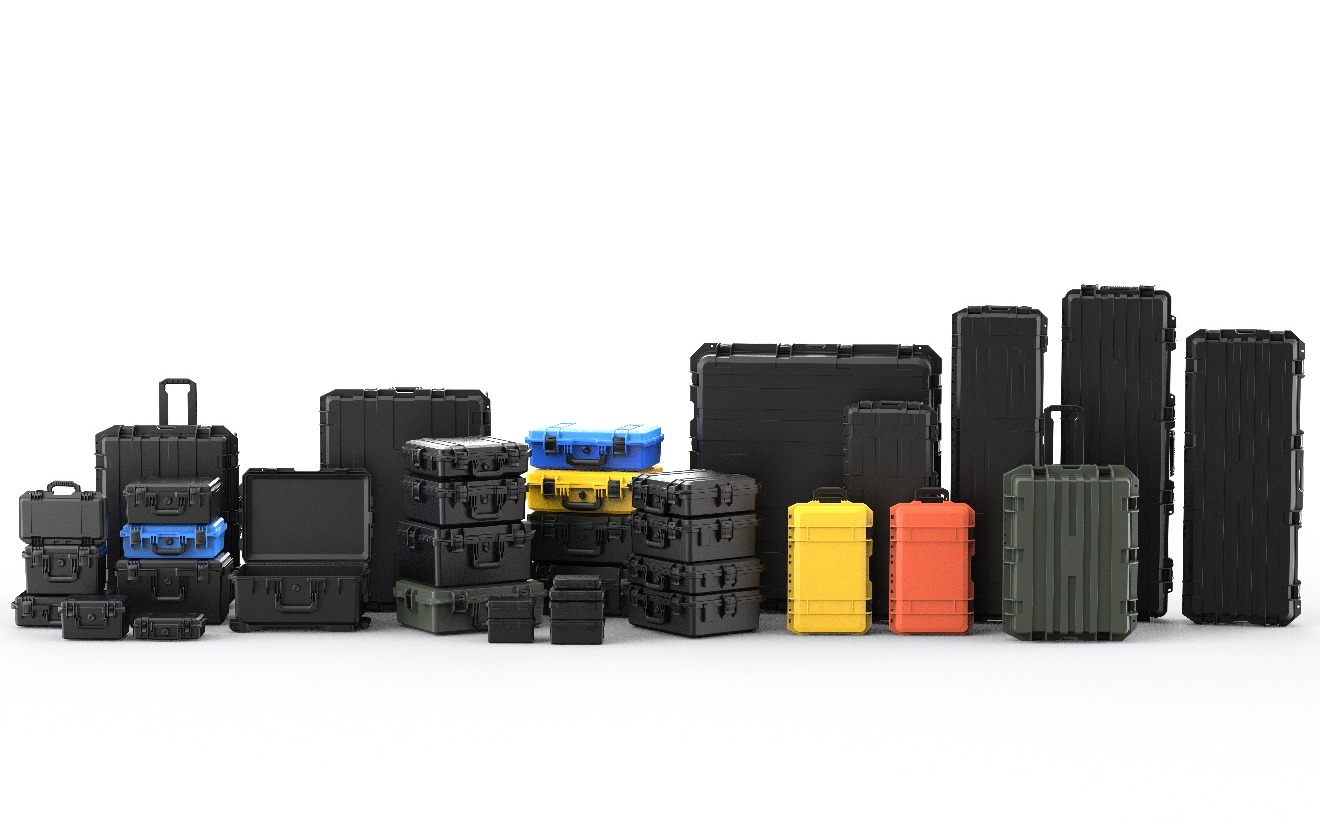
Every case has two sets of numbers. Outside dimensions tell you whether it fits on a shelf or in a van. Inside dimensions tell you whether your gear fits in it. On this site, every model page lists both, in millimetres and inches — use the inside set. Our smallest stocked model, the XYY-1370 micro box, is 135×72×28 mm inside; the largest, the wheeled XYY-110100, is 1,100×1,000×410 mm inside. Same catalogue, very different jobs.
Foam is what stops the kit moving, and foam takes space. As a rule of thumb, add 10 mm on every side of the kit for a foam lining: a 250×170×90 mm instrument needs roughly 270×190×110 mm of inside space. Pick-and-pluck foam eats a little more, because you’re cutting the cavity out of a block that sits inside the shell. Our size finder has the same idea built in — exact fit, or +5, +10 or +20 mm of clearance per side — and it tests every orientation, so a long thin item can turn on its side if that fits better.
Total depth is lid plus base, and the split matters. In our handheld range the lid is usually 25–40 mm deep and the base carries the rest — 53 mm on the shallowest model, 230 mm on the tallest. If the kit is flat, a shallow case works: the XYY-2519L is 96 mm deep inside on the same 251×180 mm footprint as the 155 mm-deep XYY-2519. If the kit is tall, you want the depth in the base, not the lid — a tall item pressing against the lid is what stops the gasket sealing. The same footprint comes in several heights for exactly this reason: the XYY-3020 is 120 mm deep inside, and the XYY-3020H is the same 300×200 mm footprint at 200 mm deep.
Say the kit is a small test instrument, 250×170×90 mm, and it needs foam around it. Add 10 mm a side and you need about 270×190×110 mm inside. The XYY-2519L (251×180×96 mm) fails on all three sides — it looks close on paper and it still doesn’t fit. The XYY-3020 (300×200×120 mm) fits with room to spare, and the extra space takes the foam. If the instrument were 20 mm taller, the next step up would be the XYY-3321 at 330×210×175 mm.
An oversized case is not a safe choice — it’s dead space, and dead space is where gear slides, knocks and breaks. If the next size up leaves more than about 30 mm of slack on a side after foam, look for a size in between, or ask us: the mould library behind this range covers more than 170 sizes, and a size that isn’t listed here may already exist. If you already know the family you need, start from its range page — the handheld cases, for example, run from the 270 mm XYY-2716 up to the 440 mm XYY-4429T, smallest to largest.
One last check before you order. If the case will ride in rain, sit on a wet deck or fly in a hold, pick a gasket-sealed waterproof model — 80 of the 95 models on this site are sealed. And a note on the IP67 figure you’ll see quoted around the industry: our SGS test to IP67 under IEC 60529 was run on one sample model, the XYY-4030, and that is what the report proves. We don’t stretch it into a blanket claim for the whole range.
Still unsure? Send us the three dimensions of the kit and what it is — we’ll tell you which models fit and which one we’d pick, usually within a day. Contact Zoe →